
Reviewed · CITY TOURS
Uppsala’s biggest attractions – 1h city walk in Uppsala city.
Uppsala’s story comes alive through its odd details: a university building whose decorations helped bankrupt its builder, an anatomical theater with no proper ventilation, and a city partly demolished for a coronation that never took place there. I like the way this walk links Uppsala University with the cathedral, castle, and streets around them, rather than treating each sight as a separate photo stop. I also like the chance to hear local stories from guides such as Anette and Jonathan, both praised for answering questions and making the past easy to follow.
The main consideration is the pace and format. The tour is advertised at about an hour, although the listed stop times add up to roughly 75 minutes, and much of the experience involves standing while the guide points out buildings. If you want a long stroll with extended interior visits, this may feel too static. If you want a compact introduction to Uppsala, it packs in a great deal.
Key points about this Uppsala city walk
- The University House opens the story: Learn how its ornate decorations caused financial trouble for the builder, then see rune stones in the university park.
- Gustavianum brings unusual science to life: Hear about Olof Rudbeck’s anatomical theater, old university collections, and the building’s curious ventilation problem.
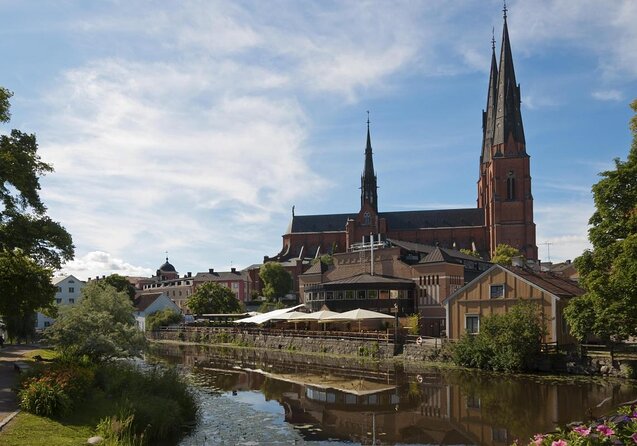
- Uppsala Cathedral anchors the medieval section: The church took from the 1270s to the 1430s to build and is the largest cathedral in the Nordic countries.
- The old university district had its own rules: St. Erik’s Square and the Consistory House reveal how the university once functioned like a city within the city.
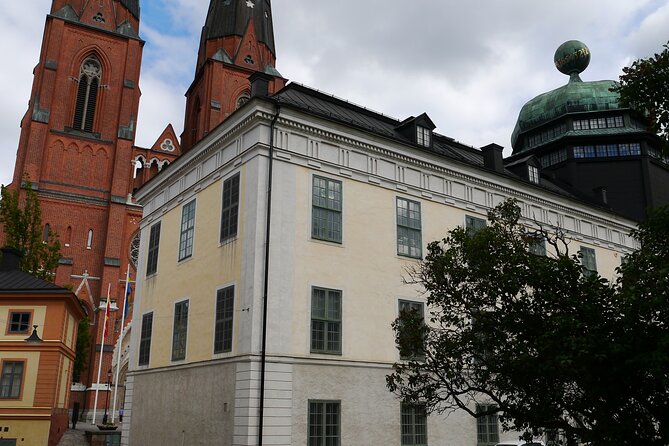
- Uppsala Castle adds royal scandal and views: Stand in the castle courtyard, hear about a murder, and look toward the Botanical Garden.
- A group of up to 20 keeps the guide accessible: You get a better chance to hear explanations and ask questions than on a large coach tour.
Why Uppsala makes a good one-hour history walk
Uppsala is compact, but its history is not. The city brings together medieval church power, royal ambition, university life, and scientific achievement in a relatively small area. This walk gives you a useful framework before you explore on your own.
I like that the tour does not focus only on famous names. You hear about Anders Celsius, Carl Linnaeus, and Olof Rudbeck, but you also hear about student discipline, construction disputes, food markets, plague, military pay, and the practical problems of old buildings. Those smaller details help you picture daily life rather than just memorize dates.
The city walk is led by an authorized Uppsala guide. Guides named in the available tour information include Anette and Jonathan. Anette is noted for answering questions during the walk, while Jonathan has led a particularly informative tour that even local residents found useful. That matters in a city with a large university population, because a good guide needs to explain both the famous sights and the parts locals may pass every day without noticing.
The group limit is 20 people. That is not a private tour, but it is small enough for a guide to keep the group together and respond to questions. You should expect a mixture of visitors and people curious about their own city.
More walking tours in Sweden:
- Stockholm: Ghost Walk and Historical Tour
★ 4.7 · 2,206 reviews - Walking Tour of Stockholm Old Town
★ 5.0 · 1,175 reviews - The Original Stockholm Ghost Walk and Historical Tour – Gamla Stan
★ 4.5 · 1,165 reviews
Riddartorget to the University House
The walk begins at Riddartorget and returns there at the end. Starting in the central area makes the tour easy to fit into a day of sightseeing, and the return to the same meeting point simplifies your plans afterward.
The first major stop is the University House. Here, the guide explains the building’s grand decoration and the financial trouble it created for the person who built it. It is a useful reminder that impressive public buildings have always come with bills, arguments, and risky decisions.
You also hear about Uppsala University and its connection to competition with Denmark. The university was founded in part so Sweden could match or surpass Danish academic institutions. That rivalry gives the university a clearer place in Scandinavian politics and culture.
The university park adds another layer. Rune stones are found among the grounds, connecting the modern academic setting with a much older Sweden. You do not need specialist knowledge to appreciate this contrast. One moment you are considering nineteenth-century university architecture, and the next you are looking at stones carved centuries earlier.
This portion is listed at about 15 minutes. It is short, but it sets up several themes that return later: ambition, competition, money, and the way old objects remain part of modern Uppsala.
Gustavianum and the anatomical theater
Gustavianum, the Uppsala University Museum, is one of the most unusual stops. The tour discusses the anatomical theater built by Olof Rudbeck. Its design was brilliant for its period, though it lacked proper ventilation. That practical flaw makes the story memorable, and it also gives you a more honest picture of early scientific work.
The anatomical theater was built for teaching anatomy, with students arranged to observe demonstrations. The tour focuses on the building’s purpose and design rather than asking you to treat it as a simple museum room. You get a sense of how university science was taught before modern laboratories and health standards.
Gustavianum also connects to university collections and older academic buildings. The party hall had to move through additional houses because the collections took up so much space. The former Academia Carolina is part of this story too. Uppsala’s academic world was not confined to one tidy campus. It spread through buildings that had to be adapted as teaching, research, and collections expanded.
The stop is listed at about 10 minutes, and admission is not included. That distinction is important. You should not assume the guided walk includes entry to the museum. Much of the visit may involve hearing about the building and its contents rather than spending a long period inside.
The tour also introduces Celsius, Linnaeus, and Rudbeck. These names can appear as isolated facts in a guidebook, but here they fit into the university setting. You hear about the people, buildings, and teaching traditions that helped make Uppsala an important center of learning.
Uppsala Cathedral, built across three centuries
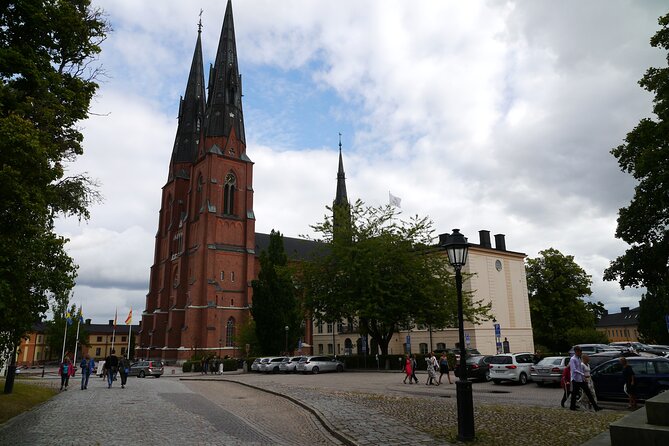
Uppsala Cathedral is the largest cathedral in the Nordic countries, and it provides the walk’s strongest medieval focus. Construction began in the 1270s and continued until the 1430s. Even without a long interior visit, that timeline tells you something about medieval building projects: they were expensive, slow, and vulnerable to political and labor problems.
The guide discusses the cathedral itself, as well as the medieval buildings around it. Kanikhus, or houses connected with the cathedral clergy, help explain how this area once worked as a religious center rather than simply a church surrounded by open public space.
The stories here are not limited to architecture. You hear about disputes involving limestone pipes and the fact that they were paid more than soldiers. Strikes followed. That is a striking detail because it brings medieval construction down to a human level. Large religious buildings depended on workers, supply chains, wages, and sometimes very unhappy laborers.
The cathedral stop is listed at about 20 minutes and admission is free. Since the timing is limited, you should expect an overview rather than a full architectural lecture or extended quiet time inside. If you want to study chapels, monuments, or artwork at length, plan to return after the tour.
This is also where the university and cathedral stories meet. Uppsala’s religious and academic institutions grew side by side, and the walk uses that relationship to explain why the city became so influential.
A few more Sweden half-days to weigh up
- Malmö: Express Walk with a Local in 60 minutes
★ 5.0 · 8 reviews - Explore Gothenburg in 60 minutes with a Local
★ 3.5 · 7 reviews - Gothenburg: Express Walk with a Local in 60 minutes
★ 4.8 · 6 reviews - Uppsala bloody history 1h- racial biology, 18th century plague, 19th century prostitution etc.
★ 5.0 · 4 reviews
St. Erik’s Square and the university city within the city
At St. Erik’s Square and the Consistory House, the tour shifts from major monuments to street-level life. You hear about the plague’s arrival in Uppsala, meat sales at Oxblodstorget, and the sheds that once leaned against the wall around the cathedral.
These details show how crowded and practical the old center could be. Cathedral precincts were not just places for worship. They included storage, trade, administration, and the ordinary business of feeding a population.
The Consistory House gives the university a more institutional face. In the 1750s, it held a prison, police function, and administration for students. The university operated almost like a city within the city, with its own rules and systems of control.
The years 1709 to 1711 receive special attention in this section. The plague’s effect on Uppsala is part of the account, and the guide places it alongside the university’s role in local life. You get a sense of how disease, authority, commerce, and education overlapped in the same few streets.
This stop is listed at about 10 minutes. It is brief, but it helps prevent the walk from becoming a parade of grand buildings. I find these smaller stories among the most useful parts of a city tour because they give you something to notice later when you walk through the center alone.
Uppsala Castle and the coronation that moved to Stockholm
The final major stop is Uppsala Castle. The guide tells the story of a murder connected with the castle, then brings you into the courtyard. From there, you look toward the Botanical Garden, described as one of the oldest botanical gardens in Europe.
The view gives the tour a pleasant change of scale. After standing among university and cathedral buildings, you get an open outlook and a chance to connect Uppsala’s academic traditions with its gardens and royal history.
The castle stop also brings in Queen Kristina’s coronation. According to the tour story, the city was voluntarily demolished before the ceremony so it could be rebuilt according to a grand plan. The work was not completed in time, and the coronation was moved to Stockholm.
That story says a great deal about royal power and urban planning. Uppsala was willing to reshape itself for a major event, yet the practical limits of time and construction defeated the plan. It is a memorable ending because it combines ceremony, ambition, demolition, and failure.
The castle stop is listed at about 20 minutes, and entry is not included. You should treat the courtyard and the view as part of the walking experience rather than expect a full castle museum visit.
What the $91.75 price means
At $91.75 per person, this is not a bargain-priced orientation walk. The value depends heavily on the guide and on how much you want historical explanation during a short visit.
You are paying for an authorized guide, a small maximum group of 20, and a tightly arranged route covering the university, cathedral, old center, and castle. The walk also includes all fees and taxes. Admission to Gustavianum and Uppsala Castle is not included, so budget separately if you want to enter either attraction.
I would compare this price with the cost of arranging several separate visits and finding the background yourself. If you are already planning to see the cathedral, university area, and castle, a guided explanation can make those places easier to understand. If you mainly want free sightseeing and photographs, the price will feel harder to justify.
The tour is most valuable for a first visit, a short stay, or anyone who enjoys local anecdotes. It can also suit residents who want to learn more about familiar streets. One local group apparently booked at the last minute and still had a successful walk, but availability can change, so I would not rely on that during a busy period.
Pace, walking, and practical details
The activity lasts about one hour, though the listed stop durations total roughly 75 minutes. That difference is worth noting when planning your day. Give yourself extra time rather than scheduling a train or meal immediately afterward.
You need a moderate level of physical fitness. The walk involves moving between several central sights and standing during explanations. Specific distances, surfaces, and seating arrangements are not provided, so you should ask the operator if you have concerns about mobility.
The meeting point is Riddartorget, and the tour ends back there. The area is near public transportation. A mobile ticket is provided, confirmation arrives at booking, and service animals are allowed.
The tour has a minimum number of participants. If that minimum is not reached and the activity is canceled, you are offered another date or experience, or a full refund. You can cancel for a full refund up to 24 hours before the start time. Changes or cancellations inside that window are not accepted for a refund.
No gratuity is included. Since the walk is guide-led and personal, you may want to allow for a tip if the service suits you, but it is not part of the listed price.
Who should book this Uppsala walk?
I would recommend it to you if you want a quick introduction to Uppsala’s main historic areas and prefer stories to silent sightseeing. It is especially useful at the beginning of a stay, when you can return to the cathedral, museum, or castle with more context.
It also suits people who enjoy unusual details. The absent ventilation in the anatomical theater, the university’s student prison, the cathedral construction dispute, and the failed coronation plan are more memorable than a list of dates.
You may want to skip it if you dislike standing, want extensive interior access, or prefer a relaxed walk with plenty of time for photographs. The tour covers many subjects quickly, and one reasonable criticism is that it can feel more like a sequence of talks at fixed points than a continuous stroll.
Should you book it?
Book this walk if you want a compact, story-filled introduction to Uppsala and do not mind paying for a guide rather than exploring the sights alone. The strongest reasons are the range of subjects, the small group cap, and the chance to ask questions of guides such as Anette or Jonathan.
Think twice if the $91.75 price stretches your budget or if you expect full admission to the museum and castle. For the right audience, this is a useful first look at Uppsala, with enough odd stories to make the city’s buildings easier to remember.
FAQ
How long does the Uppsala city walk last?
The experience is advertised as approximately one hour. The listed stop times add up to about 75 minutes, so allow some flexibility when planning the rest of your day.
Where does the tour begin?
The tour begins at Riddartorget in Uppsala, Sweden.
Where does the tour end?
The activity ends back at the meeting point at Riddartorget.
What attractions are covered?
The route covers Uppsala University Main Building and its park, Gustavianum, Uppsala Cathedral, St. Erik’s Square, the Consistory House, and Uppsala Castle.
Is admission to Gustavianum included?
No. Admission to Gustavianum is not included in the tour.
Is admission to Uppsala Castle included?
No. Admission to Uppsala Castle is not included.
Is entry to Uppsala Cathedral included?
The cathedral stop lists admission as free.
How many people can join the tour?
The maximum group size is 20 people.
Is the tour suitable for people with limited mobility?
The experience requires a moderate level of physical fitness. Detailed accessibility information is not provided, so contact the operator before booking if you need specific arrangements.
Can I cancel for a refund?
Yes. You can cancel at least 24 hours before the local start time for a full refund. Cancellations and changes made less than 24 hours before the start time are not accepted for a refund.
Just added around Sweden
- Wilderness Tour with Snowmobile & Ice Fishing★ 4.9 · 28 reviews
- World War II Stockholm Old Town Walking Tour and Army Museum★ 4.6 · 4 reviews
- Stockholm: Archipelago Guided Boat & Walking Tour of Vaxholm★ 3.1 · 23 reviews
- Vaxholm & Stockholm Archipelago: Guided Excursion, Day Trip★ 4.8 · 41 reviews
- West Sweden: Sea Kayak Delight in Nature Reserves★ 5.0 · 6 reviews
- Uppsala Must See 2h city walk – 2h tour of all big attractions!★ 5.0 · 4 reviews
- Stockholm: Underground Metro Art Ride with a Local Guide★ 4.6 · 39 reviews
- Self-Guided Audio Walking Tour Through Kurt Wallander’s Ystad★ 3.5 · 12 reviews
City Tours, compared.
City Archipelago Sightseeing Cruise with Guide
Read our review →
Guided City Sightseeing Open Electric Boat Tour
Read our review →


Go City All-Inclusive Pass with 20+ Attractions
Read our review →
Browse the lists this tour appears in