
Reviewed · HISTORICAL TOURS
Uppsala bloody history 1h- racial biology, 18th century plague, 19th century prostitution etc.
Uppsala’s grand cathedral and university town have a darker side, and this one-hour walk brings it into view. You’ll hear about plague, poverty, prostitution, slave trade, persecution, racial biology, and forced sterilization, all tied to real streets and buildings rather than presented as a dry history lecture.
I like the unusual subject matter and the way the route connects uncomfortable history to familiar places. I also like that the tour includes less-discussed stories about poor residents, dissenters, and people labeled defective by authorities. The main drawback is its serious content, and the short one-hour format means some topics are introduced quickly rather than explored at length.
Key points to know
- A one-hour walk through Uppsala’s darker past, with stops in the old poor districts and former red-light area.
- Sensitive subjects are central, including racial biology, forced sterilization, persecution, slave trade, and anatomical practices.
- The route uses real city landmarks, including Uppsala Cathedral, Gustavianum, St Erik’s Square, and Linnéträdgården.
- The group is limited to 20 people, which should make it easier to hear the guide and ask questions.
- The tour costs $36.58 per person, a fair price if you value focused local history rather than major-ticket attractions.
- Free cancellation is available up to 24 hours before the start, subject to the tour’s minimum group requirement.
A different way to read Uppsala
Many visitors come to Uppsala for the cathedral, university, and pleasant historic streets. This tour asks you to look again. The same city center also carries stories of epidemic disease, social exclusion, religious punishment, prostitution, scientific abuse, and state control over people’s bodies.
I find that approach useful because dark history is not only about dramatic crimes or famous villains. Here, the subject is also the way ordinary institutions treated poor people, dissenters, disabled people, and others who did not fit accepted social rules.
The walk is led by Sweden History Tours, with Owe and Jonathan associated with the guiding team. The available comments about the experience point to guides who explain the subjects clearly, answer questions, and add lighter facts alongside the more troubling material. That balance matters. A tour like this can become grim if every stop is presented as shock value.
You should expect a serious outing, but not a nonstop ghost walk. The emphasis is on social history and the decisions made by churches, universities, doctors, police, and government authorities.
More history walks in Sweden:
- Stockholm: Ghost Walk and Historical Tour
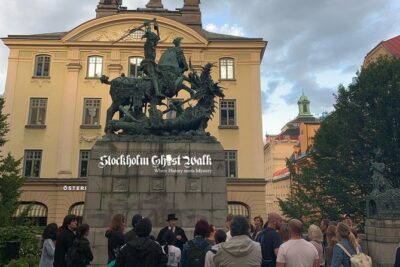
★ 4.7 · 2,206 reviews - The Original Stockholm Ghost Walk and Historical Tour – Gamla Stan
★ 4.5 · 1,165 reviews - Stockholm: Old Town Historical Walking Tour
★ 4.9 · 344 reviews
The route from the old streets to the city library
The tour information gives Riddartorget, or Knights’ Square, on Biskopsgatan as the starting point, with the City Library on Svartbäcksgatan as the end. Another description refers to a collection outside the library’s main entrance for the introduction, so I would confirm the exact meeting spot when you book.
The listed start time is 3:00 pm. Since the walk lasts about an hour, it fits neatly into an afternoon of sightseeing. You receive a mobile ticket, and all fees and taxes are included. Gratuities are not included.
The route is on foot and calls for moderate physical fitness. No long-distance transport is involved, and service animals are allowed. The maximum group size is 20 people, a useful limit for a walking tour that depends on hearing detailed explanations in city streets.
Svartbäcksgatan and the poor Uppsala
One of the early stops focuses on Svartbäcksgatan and the poorer parts of Uppsala. This is a valuable change of focus from the city’s formal monuments. Instead of seeing Uppsala only through bishops, professors, and royalty, you hear about people who lived with poverty, disease, and social pressure.
The route also covers the plague that struck Uppsala from 1709 to 1712. The material describes this as an 18th-century episode, and the dates place it firmly in the early 1700s. You will hear about the effects of epidemic disease on the city and the difficult conditions faced by people with few resources.
This stop is listed at about 20 minutes, making it one of the longer sections of the walk. That gives the guide some room to explain the setting rather than simply name the plague and move on.
I like this part because it gives the later subjects a human context. Poverty was not an abstract problem. It shaped where people lived, how they were treated, and how vulnerable they were during disease outbreaks.
The drawback is that street-based history can be less visually obvious than a museum display. You may be looking at an ordinary road while hearing about events that happened centuries ago. The guide’s explanation is therefore central to the experience.
Linnéträdgården and Uppsala’s former red-light area
The walk continues through streets outside Linnéträdgården, where Uppsala’s 19th-century red-light district was located. The tour discusses brothels, alcohol problems, and poor neighborhoods in the same area.
This section is likely to interest you if you enjoy urban history, because it shows how prostitution was part of the city rather than a distant problem. It also raises questions about poverty, public morality, and who was blamed when neighborhoods developed serious social problems.
The description does not promise visits inside former brothels, and you should not expect a preserved red-light attraction. Instead, the value comes from standing in the area and hearing what once took place there.
I appreciate that the tour does not treat prostitution as a sensational side story. It places the subject alongside housing, alcohol abuse, and poverty. That approach gives you more to think about than a list of colorful anecdotes.
This is also one reason the walk suits people who have already seen the main sights in Uppsala. If you know the cathedral and university quarter, this route gives you a less polished view of the city.
A few more Sweden half-days to weigh up
- Malmö: Express Walk with a Local in 60 minutes
★ 5.0 · 8 reviews - Explore Gothenburg in 60 minutes with a Local
★ 3.5 · 7 reviews - Gothenburg: Express Walk with a Local in 60 minutes
★ 4.8 · 6 reviews - Explore Malmo in 60 minutes with a Local
★ 4.0 · 4 reviews
St Erik’s Square and the memory of plague
St Erik’s Square is another stop connected with the plague of 1709 to 1712. The location helps anchor the epidemic in the city center, where public life, religious life, and daily trade all overlapped.
The tour’s broader point is not simply that disease happened. It is that epidemics expose social divisions. People with money, influence, or better living conditions did not face an outbreak in the same way as people living in poverty.
Because the total walk lasts only about an hour, expect a compact explanation. The guide has to move between several centuries and subjects, so this is not a specialist medical-history tour.
Still, the stop can help you read Uppsala’s streets differently. After the walk, a square or narrow lane may carry more weight than it did when you first passed through.
Uppsala Cathedral and persecution of dissenters
At Uppsala Cathedral, the subject shifts to the persecution of dissenting Christians and atheists during the 19th century. The cathedral is an effective setting for this discussion because it represents the authority of the established church and the religious structures that shaped public life.
You will hear about people who challenged accepted religious beliefs and the pressures placed on those who did not conform. The tour connects this religious history to wider questions about freedom of thought and the boundaries of acceptable behavior.
This stop is listed at about 10 minutes. That is enough for a focused introduction, but not enough for a full study of Swedish religious law or every dissenting movement. If you have a strong interest in church history, you may want to treat this as a starting point for further reading.
The cathedral itself is free to visit as part of the outdoor stop, according to the tour details. The route does not promise a dedicated interior visit or a guided cathedral tour, so consider the stop mainly as a place-based history lesson.
The Dean’s House and the Swedish Institute of Racial Biology
One of the tour’s most serious sections concerns the Swedish Institute of Racial Biology, which operated from 1920 to 1958. The discussion takes place around the cathedral and the Dean’s House.
This is not an easy subject, and it should not be treated as a curiosity. The institute’s work belongs to the history of pseudoscientific racial classification and state-backed discrimination. The tour also connects this history with forced sterilizations in the 1940s.
For me, this is one of the strongest reasons to book the walk. Sweden is often viewed from abroad as a modern, fair-minded country, but no nation should be allowed to hide the harm carried out in its name. Hearing this history in the setting where institutions and authority were concentrated makes the subject harder to dismiss as someone else’s past.
The material uses direct and unsettling language about attempts to harm or kill people considered defective. You should be prepared for blunt discussion of abuse. This is not a suitable choice if you want a light city stroll or a family outing built around amusing stories.
At the same time, the tour is only an hour long. The guide can introduce the institute and forced sterilizations, but you should not expect a full account of the victims, legal changes, or later public reckoning. The value is in learning that these subjects belong in Uppsala’s public history.
Gustavianum and the anatomy department
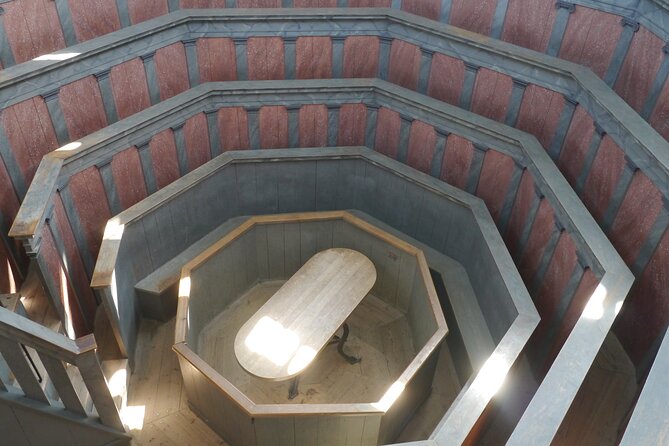
The route includes Gustavianum, Uppsala University Museum, and discusses the anatomical institution. The tour explains rules about which crimes could result in a person’s body ending up under the knife.
That subject reveals the connection between punishment, medicine, and the treatment of the dead. It also shows how institutions that claimed scientific authority could depend on bodies obtained through legal and social systems that were far from equal.
The anatomical material is paired with discussion of 19th-century phrenologists. Phrenology claimed that a person’s character could be read from the shape of the skull. Today the idea is widely recognized as pseudoscience, but it once carried a scientific appearance and helped support judgments about human worth.
Gustavianum is listed as a stop, but admission is not included. The tour details do not say that the group enters the museum, so you should budget separately if you want to visit inside. The walking experience itself includes all fees and taxes, but a museum ticket is extra.
This is a useful distinction when judging the $36.58 price. You are paying for a guided city walk, not a combined walking tour and museum admission.
Slave trade and Sweden’s uncomfortable connections
The Gustavianum section also covers Sweden’s involvement in the 17th-century slave trade. This is an important inclusion because national history is often taught through achievements, institutions, and famous figures, while exploitation is left in the margins.
The tour brings the subject into a city known for learning and religion. That contrast is useful. A university town can produce ideas that help society, but it can also participate in systems that harm people far away.
The available information does not specify which individuals, trading networks, or colonies are discussed, so you should expect an overview rather than a detailed economic history. If this is your main interest, ask the guide questions during the walk.
The group size of up to 20 should help here. A smaller walking group gives you a better chance to ask for clarification when a subject moves quickly or raises a question you did not expect.
How much value do you get for $36.58?
At $36.58 per person, this tour is not the cheapest way to see Uppsala. It is also not priced like a major museum experience. The value depends on how much you want guided interpretation.
You are paying for about an hour of local history, a route linking several difficult subjects, and access to a guide who can connect locations that may otherwise look unrelated. There are no separate admission fees for the outdoor parts, and the tour includes all listed fees and taxes.
I would book it if you have already seen Uppsala’s main sights and want something more specific. I would also consider it good value if you enjoy social history, church history, the history of science, or discussions about how governments classify and control people.
I would skip it if you want a relaxed introduction to Uppsala, a long cathedral visit, or a tour centered on architecture. The route covers many topics quickly, and some content is genuinely upsetting.
The tour is booked an average of 34 days in advance, so planning ahead is sensible. Free cancellation is available until 24 hours before the start time. If you cancel later, the payment is not refunded, and changes made inside that window are not accepted.
Who should book this dark-history walk?
This experience suits you best if you:
- Want a serious look at Uppsala beyond its famous landmarks.
- Prefer social and political history to sightseeing alone.
- Are comfortable hearing about death, disease, prostitution, discrimination, and forced sterilization.
- Like asking questions during a small-group walking tour.
- Have moderate physical fitness for an hour on foot.
- Are visiting Uppsala for more than a single quick stop.
It may not suit young children, people seeking a light-hearted activity, or anyone uncomfortable with frank discussion of state violence and medical abuse. The title promises a bloody past, and the content follows through in a historical rather than theatrical way.
Should you book Uppsala Bloody History?
Book this tour if you want to understand the parts of Uppsala that are rarely placed on a standard sightseeing route. The strongest material concerns the Swedish Institute of Racial Biology, forced sterilizations, the treatment of dissenters, and the way poverty and disease shaped everyday life.
The main compromise is speed. In one hour, the tour moves from plague to prostitution, from cathedral authority to racial science, and from slave trade to anatomy. You will leave with a sharper sense of the city’s difficult past, but you may also want to read more afterward.
At $36.58, I see it as a worthwhile specialist walk for curious adults and history-minded visitors. Choose it for honesty and unusual local context, not for easy entertainment.
FAQ
How long is Uppsala Bloody History?
The walking tour lasts approximately one hour.
What time does the tour start?
The listed start time is 3:00 pm.
Where does the tour begin?
The meeting information gives Riddartorget, also called Knights’ Square, on Biskopsgatan as the starting point. Another tour description refers to an introduction outside the main entrance of Uppsala City Library, so confirm the exact meeting location when booking.
Where does the tour end?
The listed endpoint is Uppsala City Library at Svartbäcksgatan 17, 753 75 Uppsala.
How much does the tour cost?
The listed price is $36.58 per person.
Is the ticket mobile?
Yes. The experience provides a mobile ticket.
What topics are covered?
The tour covers the 17th-century slave trade, Uppsala’s gallows hill, poverty, the plague of 1709 to 1712, the 19th-century red-light district, persecution of dissenters and atheists, racial biology, anatomy, phrenology, and forced sterilizations in the 1940s.
Is admission to Gustavianum included?
No. Admission to Gustavianum is listed as not included.
How large is the tour group?
The tour has a maximum of 20 people.
Can I cancel for a full refund?
Yes, if you cancel at least 24 hours before the experience start time. Cancellations made less than 24 hours before the start are not refunded.
Just added around Sweden
- Wilderness Tour with Snowmobile & Ice Fishing★ 4.9 · 28 reviews
- World War II Stockholm Old Town Walking Tour and Army Museum★ 4.6 · 4 reviews
- Vaxholm & Stockholm Archipelago: Guided Excursion, Day Trip★ 4.8 · 41 reviews
- West Sweden: Sea Kayak Delight in Nature Reserves★ 5.0 · 6 reviews
- Stockholm: Archipelago Guided Boat & Walking Tour of Vaxholm★ 3.1 · 23 reviews
- Uppsala Must See 2h city walk – 2h tour of all big attractions!★ 5.0 · 4 reviews
- Stockholm: Underground Metro Art Ride with a Local Guide★ 4.6 · 39 reviews
- Self-Guided Audio Walking Tour Through Kurt Wallander’s Ystad★ 3.5 · 12 reviews
Historical Tours, compared.

The Original Stockholm Ghost Walk and Historical Tour – Gamla Stan
Read our review →
Viking History, Runes & Countryside 9h Tour to Sigtuna & Uppsala
Read our review →
Stockholm Viking History Full Day Tour to Sigtuna + Uppsala
Read our review →
Viking History and Swedish Countryside Tour to Sigtuna & Uppsala
Read our review →
Viking History Small Group Tour from Stockholm: Half Day Including Sigtuna
Read our review →
Stockholm Old Town Gamla Stan, Historic Walking Tour, Small group
Read our review →Browse the lists this tour appears in