
Reviewed · SNOWSHOE TOURS
Snowshoe in a Winter Forest
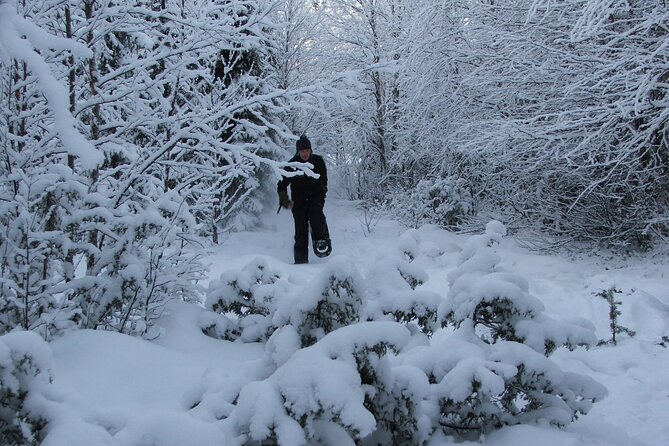
Kiruna’s snowy forest is not just a pretty backdrop. It is a place to read the tracks of animals, learn how they survive the Arctic year, and hear how people live in Sweden’s far north. This easy 2 to 2.5 kilometer walk is led by Anders, a warm and engaging local guide who brings the woods to life with stories about wildlife, Kiruna, mining, and Sami culture.
I like the small group of no more than eight and the simple pace. I also like the pause by the fire, where hot homemade berry juice and a traditional Kangoskaka cookie turn a cold-weather outing into a cozy break. The main thing to plan for is clothing: snowshoes are included, but no winter gear is supplied, so you must arrive dressed for the weather.
Key points to know before booking
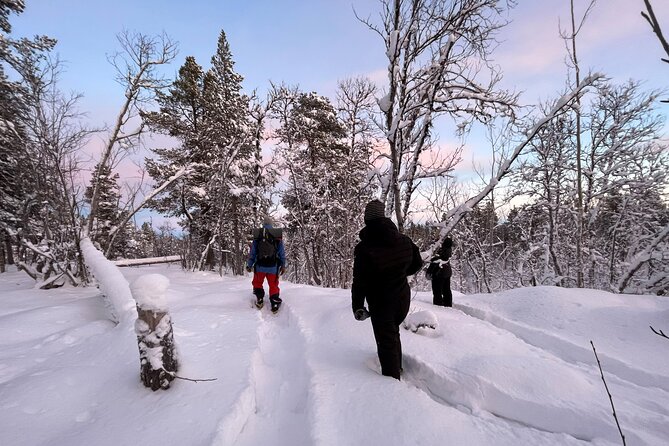
- Easy forest route: Walk about 2 to 2.5 kilometers on snowshoes, with no special skill required.
- Wildlife detective work: Anders points out animal tracks and explains what they reveal about Arctic life.
- Local stories included: The outing covers Kiruna, mining, the natural environment, and Sami culture.
- Warm pause by a fire: Homemade berry juice and Kangoskaka cookies are included.
- Small-group setting: A maximum of eight people gives the guide time to help with equipment and questions.
- Bring your own winter clothing: Snowshoes and a headlamp are provided, but coats and other warm layers are not.
A gentle way to enter Swedish Lapland
This experience is best understood as a nature walk with snowshoes, not a demanding winter expedition. You cover a short distance at an easy pace, stopping to examine the forest and discuss what you see. The activity is designed for people who want time outdoors without committing to a strenuous trek.
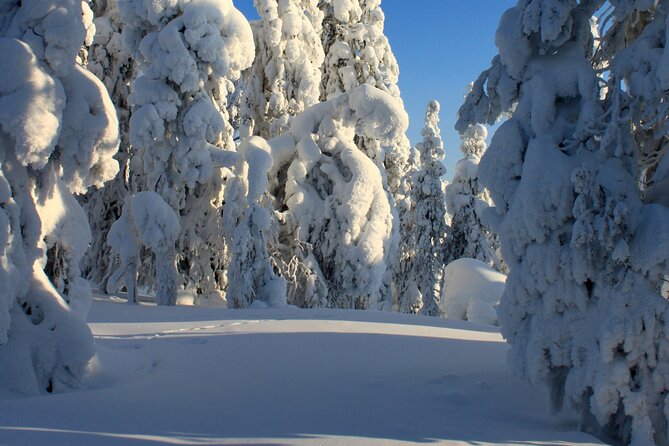
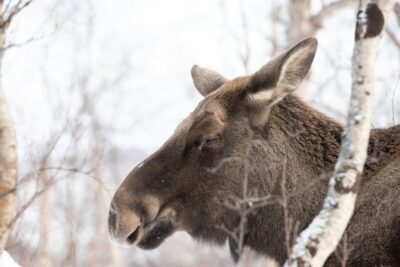
The forest itself is the main attraction. Snow changes the feel of familiar trees and paths, making the area quieter and more spacious. Depending on the conditions, you may see animal tracks crossing the snow even if the animals remain out of sight. That is an important point: this is a wildlife-tracking experience, not a guaranteed animal-sighting tour.
Anders focuses on the small clues. A set of prints can lead to a conversation about movement, feeding, shelter, and the challenge of surviving through the Arctic year. You might learn more from a few marks in the snow than from simply walking past the trees.
The easy pace also makes this a good choice if you are new to snowshoeing. You do not need previous experience, and Anders helps with the equipment. The short route gives you room to enjoy the forest instead of worrying about keeping up.
More snowshoe walks around Kiruna:
- Snowshoe up a Mountain
★ 5.0 · 19 reviews - Abisko: Wilderness Snowshoe Hike
★ 4.8 · 94 reviews - Abisko: Aurora Snowshoeing
★ 4.7 · 59 reviews
Meeting Anders and getting into the forest
The activity begins at 10:00 a.m. Pickup is offered from central Kiruna in a black minivan marked with the on67° logo. The published pickup information lists Camp Ripan, the Tourist Information location, and Hotel Scandic. Another set of instructions also refers to Hotel Arctic Eden in the old town.
The timing information varies slightly between the pickup notes. Camp Ripan is listed at either 10 or 15 minutes before the start, while Hotel Scandic is listed as the final pickup point close to the start time. Check your booking confirmation carefully and be ready early, especially at Camp Ripan or any old-town pickup.
This transfer is useful in Kiruna, where you may be staying in different parts of the town. You do not need to arrange a separate taxi to reach the starting area, and the ride keeps the morning simple. Since the vehicle is small, the group already begins with a more personal feel.
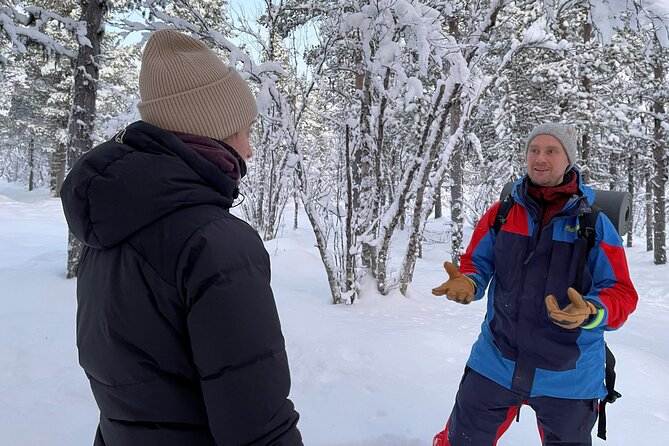
Anders is the sort of guide who pays attention to the group’s pace. His role is not just to lead from the front. He helps people with the snowshoes, checks that everyone is comfortable, and explains what the forest is showing you. That matters on snow, where a small adjustment to your footing can make the walk much easier.
Snowshoes, distance, and the pace of the route
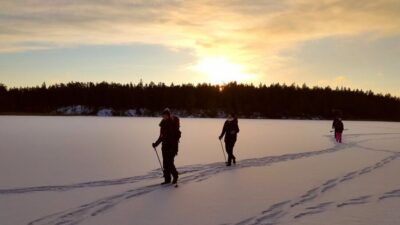
The route covers roughly 2 to 2.5 kilometers and lasts about two and a half hours in total. The distance is modest, but the time allows for stops, explanations, equipment help, and the fire break. You should not expect two and a half hours of continuous walking.
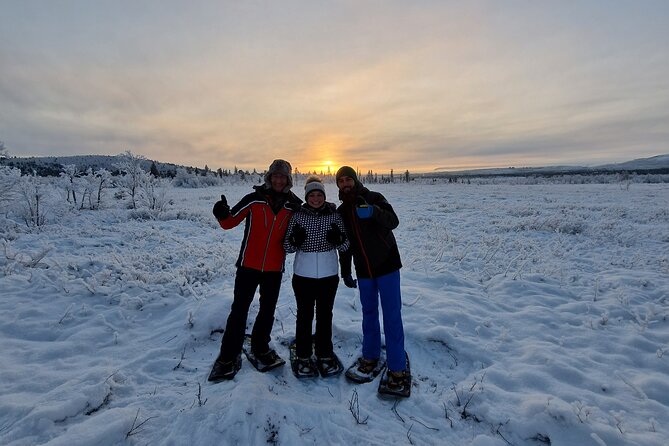
Snowshoes spread your weight across the snow, making it possible to walk through winter conditions without sinking as deeply. The basic motion is straightforward, though it can feel awkward for a few minutes. Walk with a slightly wider stance and take steady steps. Anders can help you get used to the gear before the route settles into its rhythm.
The activity is rated easy, and no particular snowshoeing skill is required. That makes it suitable for beginners and for people who want a low-pressure introduction to Arctic outdoor life. The minimum age is 12, so this is not a small-child activity.
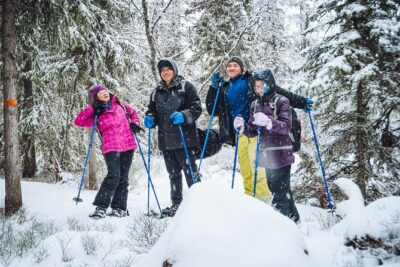
You should still take the weather seriously. Easy does not mean warm or dry. The forest may feel calm, but you will be outdoors in winter conditions, and the tour operator does not provide additional clothing. Wear a proper winter coat, warm trousers, gloves, a hat, and suitable footwear. The exact clothing needed depends on the day, so check the forecast before leaving your hotel.
Reading animal tracks in the snow
The most distinctive part of the walk is the attention given to animal tracks. Instead of treating the forest as a silent white scene, Anders shows you how to look at it. Tracks become evidence of movement and behavior.
You may see prints from animals that passed through earlier, along with other marks in the snow. Anders can identify the tracks and discuss what the animal may have been doing. This turns a simple walk into a lesson in Arctic ecology without making it feel like a classroom.
The experience is especially rewarding for anyone who likes details. Look down as well as ahead. Notice the spacing between prints, the direction of travel, and where a trail crosses the path. Snow preserves clues that would be harder to see in another season.
You may not see wildlife in person. That is normal, and the experience does not promise otherwise. The quiet forest and the signs left behind are the point. If you need a guaranteed encounter with animals, this is not the right tour. If you enjoy learning how to notice more, it offers a better connection with the place.
The guide also discusses the trees, undergrowth, and natural setting. This gives the walk some depth. You are not only being shown a route through the woods. You are learning how the parts of the forest fit together and how life continues under snow and cold.
A few more Kiruna half-days to weigh up
- Kiruna: Cross-Country Skiing Tour with a Guide
★ 5.0 · 3 reviews - Stockholm: Winter Snowshoe Full-Day Hike
★ 4.8 · 57 reviews - Snowshoe Winter Hike from Stockholm
★ 5.0 · 27 reviews - Luleå: Nordic Touring Skiing Adventure
★ 5.0 · 7 reviews
Kiruna, mining, and Sami culture along the way
The walk also reaches beyond nature. Anders talks about life in Kiruna, the area’s mining industry, and Sami culture. These subjects help explain the region as a lived-in place rather than a remote winter postcard.
Kiruna’s identity is closely tied to its northern location and mining. Hearing about the town during a forest walk gives you a useful sense of how work, settlement, and the surrounding environment meet here. The natural setting is not separate from local life. It shapes how people move, work, and spend time outdoors.
The Sami cultural context adds another important layer. This is not presented as a staged cultural show. Instead, it forms part of the wider conversation about the region and its people. You get a chance to connect the snowy forest with the human traditions and modern life of Swedish Lapland.
Anders grew up in the area, and his familiarity with Kiruna comes through in the way he links local facts to what you are seeing. His humor and enthusiasm help keep the information easy to absorb. You can ask questions as you walk rather than wait for a formal talk at the end.
The fire break, berry juice, and Kangoskaka
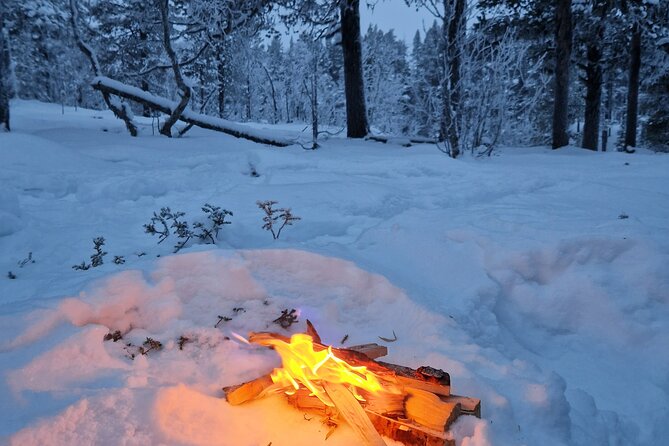
At some point along the route, you stop for a warm drink and a traditional cookie. The included homemade berry juice is served hot, and the break also includes Kangoskaka, a local-style cookie. The food is simple, but it fits the setting perfectly.
A pause by the campfire gives your feet a rest and lets you warm your hands. It also creates a natural moment to talk with Anders and the rest of the group. This is one of the details that makes the outing feel more personal than a basic equipment rental followed by a marked trail.
The berry drink is often described as lingonberry juice, with a tart, warm flavor that suits the cold air. The cookie adds a sweet bite. You should not book this expecting a full meal. Think of it as a generous snack and a welcome comfort stop during a winter walk.
The fire break also changes the pace of the activity. You have time to take in the trees, listen to the quiet, and enjoy the warmth without rushing back to town. On a short tour, small moments like this often become the most memorable.
What the $146.65 price gets you
At $146.65 per person, this is not the cheapest way to spend a morning in Kiruna. The value depends on what you want from a winter outing.
You are paying for round-trip pickup, a local guide, snowshoe equipment, instruction, a small group, the forest walk, the cultural and wildlife interpretation, and the homemade drink and cookie. The guide’s role is a major part of the price. Without that guidance, you could walk through snowy trees, but you would miss much of the meaning in the tracks, plants, and local stories.
The group limit of eight also matters. In a larger outing, questions can get lost and the guide may have less time to help with snowshoes. Here, the small format gives Anders room to adjust the pace and speak with people directly.
I see the price as fair for a visitor who wants a guided introduction to the region rather than a bare-bones snowshoe rental. It is less compelling if you already own winter equipment, prefer to explore alone, or are looking only for a long-distance hike.
The included transfer adds practical value. Central pickup saves time and removes some transport planning, especially if you are unfamiliar with Kiruna. Just remember that warm clothing is not part of the package. You need to budget for your own winter gear, or arrange it separately if you did not bring suitable clothing.
Who will enjoy this Kiruna activity most
This outing suits adults and children aged 12 or older who want an easy outdoor experience with plenty of explanation. Beginners should feel comfortable, provided they arrive dressed for the conditions. The short route also works well for anyone who wants to combine a forest activity with other Kiruna plans later in the day.
Nature lovers will get the most from the animal-track work and the discussion of Arctic survival. People interested in the area’s culture and modern life will appreciate the references to Sami culture, mining, and Kiruna itself.
It is also a good choice if you prefer a quiet, small-group activity. The tour does not center on speed, competition, or a dramatic physical challenge. It gives you time to stop, ask questions, and notice the forest.
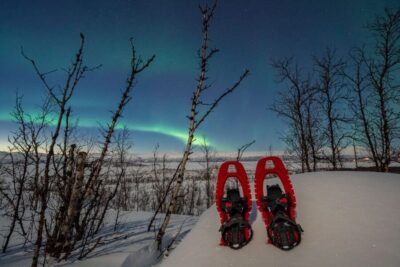
You may want to choose something else if you are seeking a long snowshoe trek, a guaranteed animal encounter, or a tour centered mainly on the northern lights. None of those is promised here. This is a daytime forest experience, with the emphasis on interpretation and a relaxed walk.
Timing, clothing, and cancellation advice
The activity starts at 10:00 a.m. and lasts about two and a half hours. Pickup is offered from central Kiruna, and a headlamp can be provided if needed. Even though the tour starts during daylight, winter light can be limited, so the headlamp is a useful practical touch.
Wear layers that you can adjust. A warm outer coat, insulated trousers, gloves, a hat, and sturdy winter footwear are essential choices for the conditions. Since snowshoes are supplied but extra clothing is not, do not assume the operator will fill gaps in your outfit.
Confirmation is provided at booking, and most people can take part. The maximum group size is eight. The minimum age is 12.
Free cancellation is available up to 24 hours before the local start time for a full refund. Cancellations or changes made less than 24 hours before the start are not refunded or accepted, so keep an eye on the local time in Kiruna when making plans.
Should you book Snowshoe in a Winter Forest?
I would book this if you want a gentle, well-explained introduction to Swedish Lapland. The strongest reasons are the small group, Anders’s local insight, the animal-track focus, and the warm fire stop with berry juice and Kangoskaka.
The main caution is simple: bring serious winter clothing, and keep your expectations realistic about wildlife. You might see tracks rather than animals, and the route is short rather than strenuous.
For a first snowshoe outing, a quiet way to explore Kiruna’s forest, or a nature activity with genuine local context, this is a good choice. It offers more than a walk through snow, but it does not ask you to be an experienced winter hiker.
FAQ
Where does the snowshoe experience take place?
The activity takes place in the winter forest near Kiruna, Sweden.
What time does the activity start?
The scheduled start time is 10:00 a.m.
How long does the experience last?
The activity lasts approximately two and a half hours.
How far do you walk?
The route covers about 2 to 2.5 kilometers.
Is the snowshoe walk difficult?
The activity is rated easy, and no particular snowshoeing skill is required.
Is snowshoe equipment included?
Yes. Snowshoes are provided, and the guide helps with the equipment.
Is winter clothing provided?
No. Additional clothing is not provided, so you must dress according to the weather and the activity.
Where is pickup available?
Pickup is offered from central Kiruna locations including Camp Ripan, the Tourist Information location, and Hotel Scandic. The pickup notes also refer to Hotel Arctic Eden in the old town, so check your booking details for the exact meeting point and time.
What is included besides the snowshoes?
The experience includes a local guide, hot homemade berry juice, a homemade traditional cookie called Kangoskaka, and a headlamp if needed.
Can children join the activity?
The minimum age is 12 years.
How many people can join the group?
The maximum group size is eight people.
Is cancellation free?
Yes. You can cancel up to 24 hours before the local start time for a full refund. Changes or cancellations made less than 24 hours before the start are not accepted or refunded.
More Winter Days out in Kiruna
- Stockholm: Winter Kayaking, Swedish Fika and hot Sauna Experience
★ 5.0 · 156 reviews - Stockholm Winter Boat Tour with Guide
★ 4.0 · 25 reviews - Winter Kayak Tour in Stockholm City (Dry Suit Kayaking)
★ 5.0 · 18 reviews - Stockholm: Winter City Kayaking Tour
★ 5.0 · 16 reviews
Just added around Kiruna
- Wilderness Tour with Snowmobile & Ice Fishing★ 4.9 · 28 reviews
- Husky Sled Ride Northern Lights Tour from Kiruna★ 5.0 · 43 reviews
- Discover Kiruna: A Walk Through History and Nature★ 4.0 · 3 reviews
- Snowshoe up a Mountain★ 5.0 · 19 reviews
- Snowmobile Safari to Lapland viewpoint★ 5.0 · 7 reviews
- Northern Light Photo tour★ 4.5 · 18 reviews
- Arctic Adventure with Reindeer and Northern Lights Hunt 18:30 pm★ 4.5 · 20 reviews
- Guided Northern Lights Tour at Kiruna★ 3.5 · 28 reviews
Snowshoe Tours, compared.
Browse the lists this tour appears in